







intoPIX

More than compression — wavelet scaling

05.06.26 08:45 AM By intoPIX

   ⏱ 7 min read

JPEG XS & WAVELET TECHNOLOGY

Most people think of JPEG XS as a low-latency compression codec — and it is. But there is a capability built into its wavelet architecture that goes far beyond simple compression: the ability for any receiver to independently decode a full 4K frame, an embedded HD layer, or a specific crop region, all from the same single compressed stream. This is wavelet scalability, and it changes how you think about video distribution over IP.

Why wavelets are different

Traditional video codecs — H.264, H.265, even JPEG 2000 in many configurations — compress a frame by predicting differences between frames or blocks. To decode any part of the image, a receiver typically needs the entire compressed bitstream for that frame.


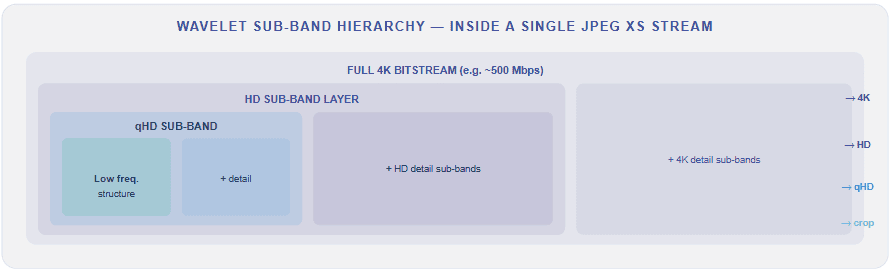
JPEG XS is a wavelet-based codec. A wavelet transform decomposes an image into a hierarchy of frequency sub-bands — low-frequency components that carry the overall structure of the image, and progressively higher-frequency components that add fine detail. This hierarchy is preserved in the compressed bitstream.

The key insight: because the bitstream is structured by frequency sub-band, a receiver can choose to decode only part of it — and get a valid, complete image at a lower resolution. The low-frequency sub-bands alone reconstruct a small version of the image. Adding more sub-bands increases resolution progressively. This is called resolution scalability, and it is inherent to the wavelet architecture — not an add-on feature.

What this means in practice

In a JPEG XS stream, the wavelet decomposition means a single compressed bitstream simultaneously contains:


  • The full resolution image — 4K, 1080p, or whatever the source resolution is
  • An embedded half-resolution layer — HD from a 4K stream, for example
  • An embedded quarter-resolution layer — and so on down the hierarchy
  • The ability to crop a region— decode only a spatial sub-region of the frame without decoding the full image

Critically, these sub-images are not separate streams. They are embedded in the single compressed bitstream. A receiver that only needs HD from a 4K source can do so by partially decoding the existing stream — no re-encoding at the sender, no separate network path, no extra bandwidth.

Wavelet Sub-Band Hierarchy - inside a single JPEG XS stream - intoPIX

The PROXY stream — a concrete example

The most immediately useful application of wavelet scalability in a real product is the PROXY stream. Here is how it works in the context of the intoPIX Titanium FPGA SoC EDK:


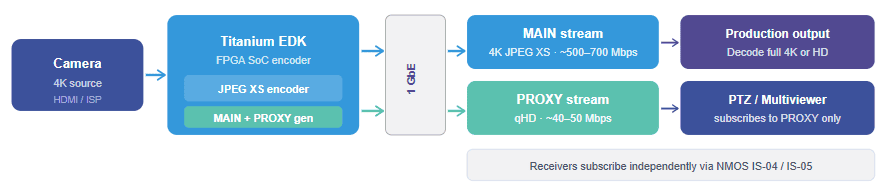
A camera or encoder transmits a MAIN stream — 4K60 JPEG XS, typically 500–700 Mbps — over a single 1 GbE link. Simultaneously, the same sender can generate a PROXY stream — a secondary, independently addressable stream at qHD resolution (960×540), approximately 40–50 Mbps — derived directly from the wavelet coefficients during encoding, with no separate encode pass required.

Both streams travel over the same single 1 GbE link. Receivers subscribe to either stream independently using SDP or NMOS IS-04/IS-05. A PTZ controller or multiviewer subscribes only to the PROXY — it never receives the 4K data it doesn't need. A production switcher subscribes to the MAIN. Neither affects the other.

What this saves: in a traditional uncompressed or DCT-based workflow, providing a low-resolution monitoring feed requires a separate downscaler, a separate encoder, separate network bandwidth, and separate cables. With JPEG XS wavelet scalability, it is a byproduct of the encoding process — no extra hardware, no extra bandwidth beyond the PROXY stream itself.

Decoding inside the MAIN stream — 4K, HD, qHD or crop

The PROXY is a separate stream, but the MAIN stream itself also carries embedded scalability. A receiver decoding the MAIN stream can choose to decode at reduced resolution by simply processing fewer wavelet sub-bands:

  • Full 4K— decode all sub-bands, full detail, full processing cost
  • HD (or qHD) from 4K — decode only the low-frequency sub-bands, get a valid 1920×1080 image at roughly one-quarter the decoding complexity, or a 960x540 image at roughly one-16th the decoding complexity.
  • Spatial crop — decode only the sub-bands corresponding to a specific region of interest in the frame, without decoding the full image — useful for PTZ digital zoom, forensic analysis, or region-of-interest workflows

This is particularly relevant for receivers with limited processing budget— embedded systems, SoCs, or applications that need to monitor a 4K feed without the cost of a full 4K decode pipeline.

CapabilityJPEG XS (wavelet)H.264 / H.265
Sub-frame latency✓ (line-based)High latency
Resolution scalability✓ inherentLimited / profiles
Spatial crop decode
PROXY from MAIN encode✓ no re-encodeRequires re-encode
Visually losslessLossy
FPGA hardware feasible✓ low gate countHigh complexity

Note : JPEG 2000 also uses wavelets and supports scalability, but its hardware and software encoding complexity and latency make it unsuitable for the sub-5 ms glass-to-glass targets that JPEG XS achieves. JPEG XS was specifically designed to be implementable in hardware with minimal gate count — which is why it fits for example into an FPGA without requiring a large Programmable Logic footprint.

Real-world use cases

BROADCAST 

Camera → production switcher + multiviewer

The studio camera sends one MAIN stream. The production switcher subscribes for the full 4K feed. The multiviewer subscribes to the PROXY — all over the same 1 GbE link, no additional infrastructure.

MEDICAL

Surgical camera → OR display + remote monitoring

The surgical camera streams full 4K to the OR display with <5 ms latency. A remote monitoring workstation subscribes to the PROXY — adequate quality for observation, minimal network load across the hospital network.

PROAV

4K endpoint + PTZ controller

An IPMX camera sends MAIN + PROXY. The display wall decodes 4K. The PTZ controller uses the PROXY feed for its low-latency joystick control loop — without wasting bandwidth on a 4K stream it would never use.

ROBOTICS

High-res sensor + low-latency control loop

A robot vision system captures high-resolution imagery. The AI inference pipeline subscribes to a cropped region of interest. The operator interface subscribes to the PROXY. The full sensor feed is archived independently.

What intoPIX delivers

Wavelet scalability is not a theoretical capability — it is implemented and shipping across the full intoPIX product range, from standalone codec IP cores to complete embedded development kits and turn-key solutions.

Codec IP cores & SDKs

  • TicoXS — JPEG XS High profile encoder and decoder, available as an FPGA IP core and as a software SDK for x86-64 and ARM platforms. Supports full resolution scalability and PROXY stream generation from the wavelet during encoding.
  • TicoXS FIP — JPEG XS High + TDC (Flawless Imaging Profile) encoder and decoder. Designed for acquisition and mastering workflows requiring maximum fidelity at 4:4:4, with the same wavelet scalability as TicoXS.
  • TicoRAW — a wavelet-based codec for RAW sensor data, bringing the same scalability principles to camera RAW workflows. Enables resolution and region-of-interest scalability directly from compressed RAW streams, without demosaicing at full resolution first.

IP Transport - Embedded Development kits / Software Development Kits

  • Titanium FPGA SoC EDK — complete ST 2110 / IPMX development kit for AMD Zynq Ultrascale+. TicoXS and TicoXS FIP run as FPGA IP cores in the Programmable Logic, with PROXY stream generation and independent NMOS-selectable stream subscription included. TX and RX packages available. Runs over the integrated 1G GigE port — no external PHY or NIC required.
  • Titanium SoC EDK — ST 2110 / IPMX development kit for ARM64 SoCs including Nvidia Jetson, Qualcomm, Rockchip,.... TicoXS runs as a software codec accelerated on the ARM CPU and GPU. Full wavelet scalability available, including PROXY stream generation and resolution-scalable decode.
  • Titanium SDK — ST 2110 / IPMX SDK for x86-64 Windows and Linux workstations and servers. CPU or GPU-accelerated TicoXS encoding and decoding with full wavelet scalability, PROXY stream support, and resolution-selectable decode for monitoring workflows.

One capability, every platform. Whether you are building on an FPGA SoC, an ARM embedded system, or an x86 server, the same JPEG XS wavelet scalability — MAIN + PROXY generation, resolution-scalable decode, spatial crop — is available through the same intoPIX product family. 

詳細情報
詳細情報

Want to add JPEG XS wavelet scalability to your design?

Talk to our engineers about our Codecs and Titanium EDKs & SDKs — available today .

Contact our engineers

 関連コンテンツ

Product: TicoXS and TicoXS FIP FPGA
JPEG XS compression IP cores for HD & 4K at the speed of light!
Learn About JPEG XS
Read more about the JPEG XS Standard vs other compression technologies
On-demand Webinar: JPEG XS for IMPX 
​Efficiency and interoperability in Pro-AV over IP